Diving the Deep, Technical Wrecks of the Red Sea
Red Sea, Egypt | rEvo CCR | 65 – 86m | 2025
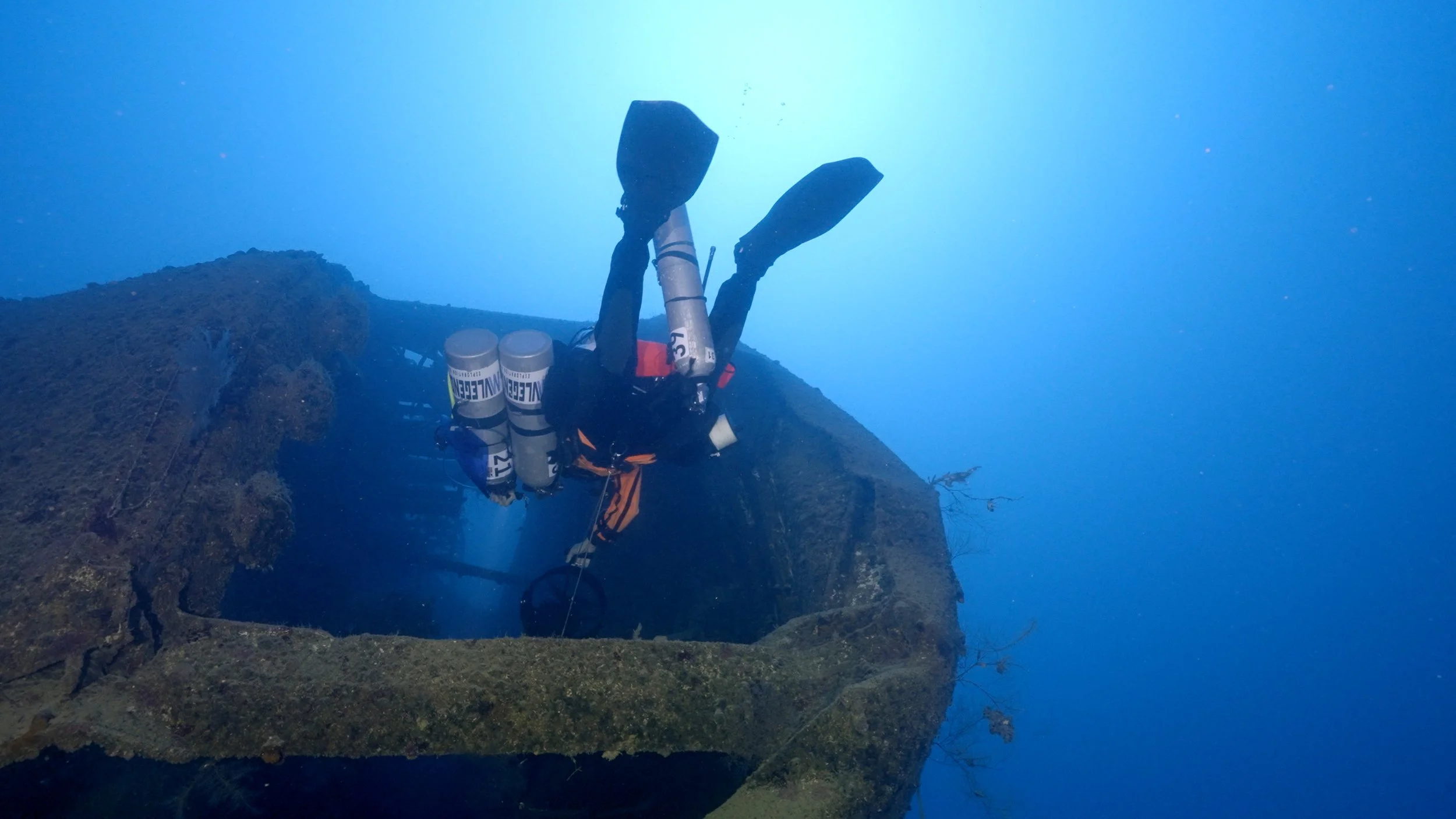
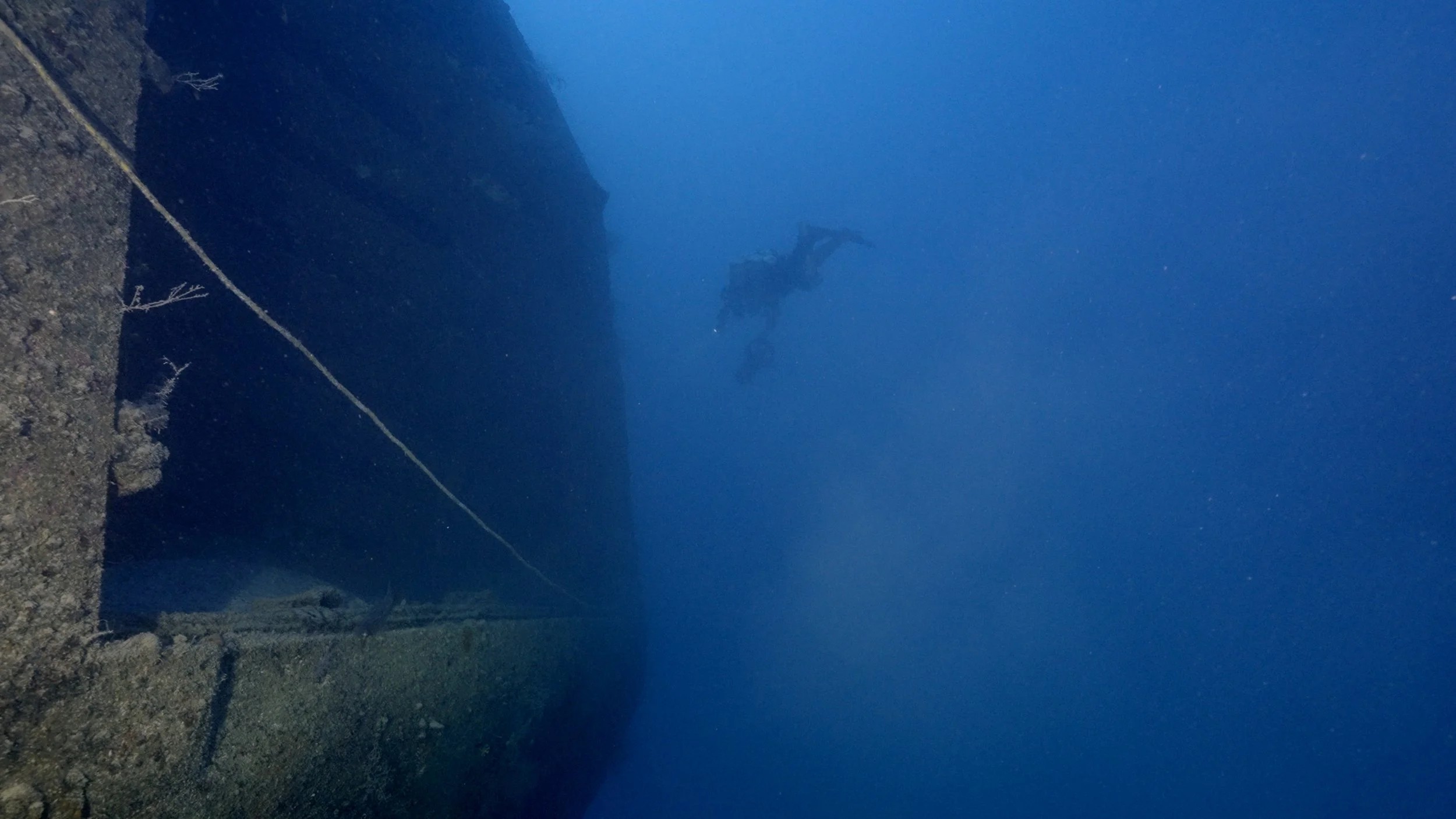
Descending into blue water with no land masses in sight, Al-Qamar Al-Saudi Al-Misr appears like the shadows of a giant, emerging from the dark waters in the blue.
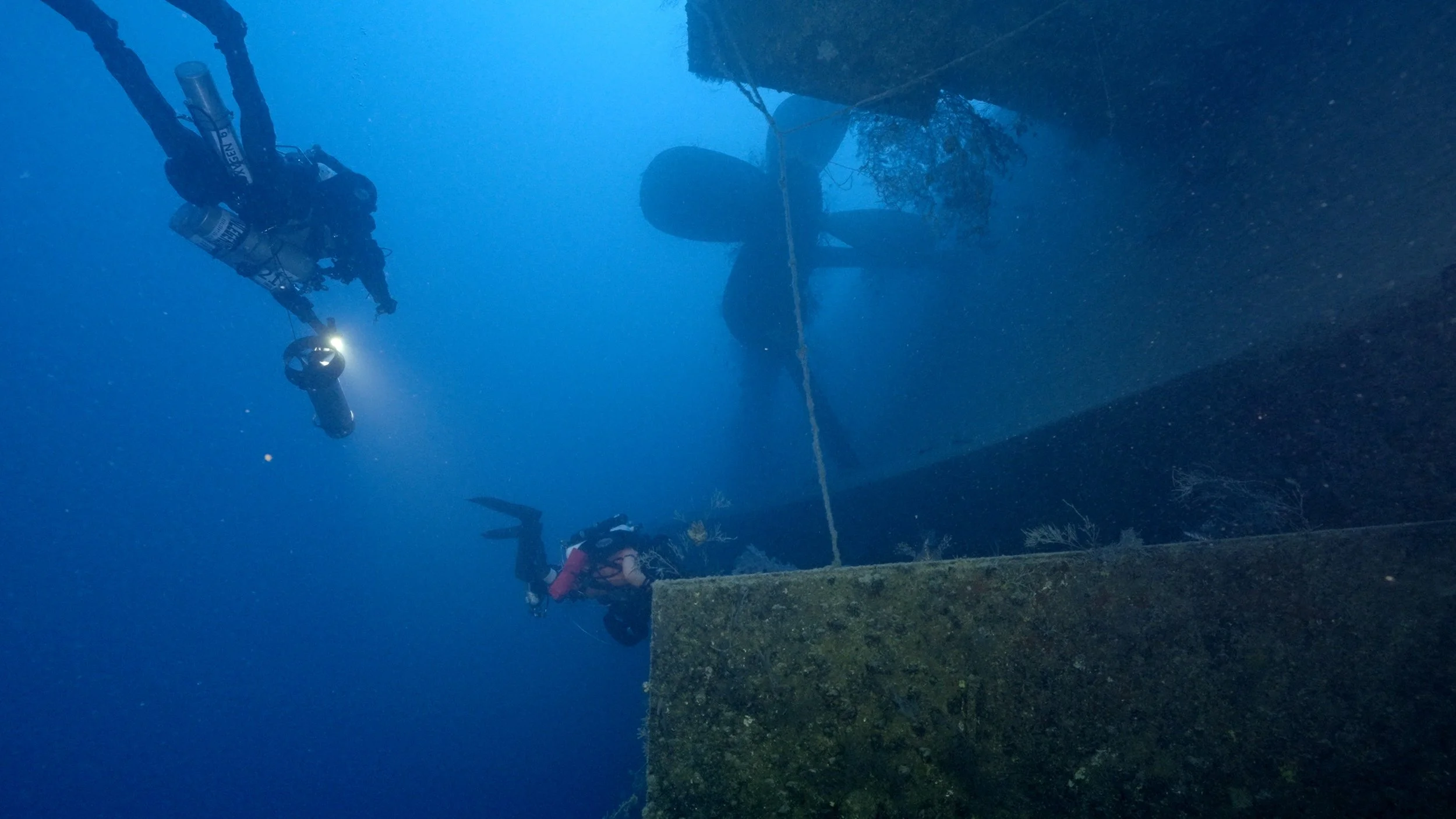
Sitting at a depth of 86 meters and lying on her port side, the ship that became the Al-Qamar Al-Saudi Al-Misr (“Al-Qamar”) wreck, started her journey as a Roll On/Roll Off Passenger Ferry, serving routes in the Mediterranean before she succumbed to the ocean while serving three national ports in the Red Sea.
This dive was as much about the dive as it was about the wreck. Not only was the creeping sight of this long forgotten behemoth emerging from the darkness overwhelming, but so were the dives ahead of us.
Spending between 45 and 57 minutes at an average depth of 75 meters meant the team had between three and a half and four hours of decompression, before we could break the surface, get warm, eat, and rest, continuing to off-gas through the night that followed.
Carrying three to four bail out stages and decompression gases each, a diver propulsion vehicle or DPV in one hand, and for me, a full underwater camera rig in the other, meant there was no margin for error whatsoever. A straight ascent from those depths with those times simply isn’t an option.
There is then the wreck itself. I was still deciding how I felt about shipwrecks at the time. Human-built wreckage in the ocean is pollution. It isn’t meant for that environment. Shipwrecks pose an interesting paradox - they are degrading; disbursing pollutants into the food chain as salt water eats away at their components, and also leak fuel, as I imagine it is rare for a ship to be completely devoid of fuel if it is not sunk intentionally.
As Leigh Bishop, legendary wreck explorer, put it at a talk I attended recently, “the best time to dive wrecks is right now; soon, they will all be nothing more than iron ore deposits on the ocean floor”. At the same technical diving conference, Matt Carter, marine archaeologist, talked about projects being done to: assess the fuel load of sunken wrecks, determine the imminence of leakage with surveys and sampling, and finally, plan big, complex missions to extract this fuel so it does not impact coastal communities and the marine ecosystems that sustain them.
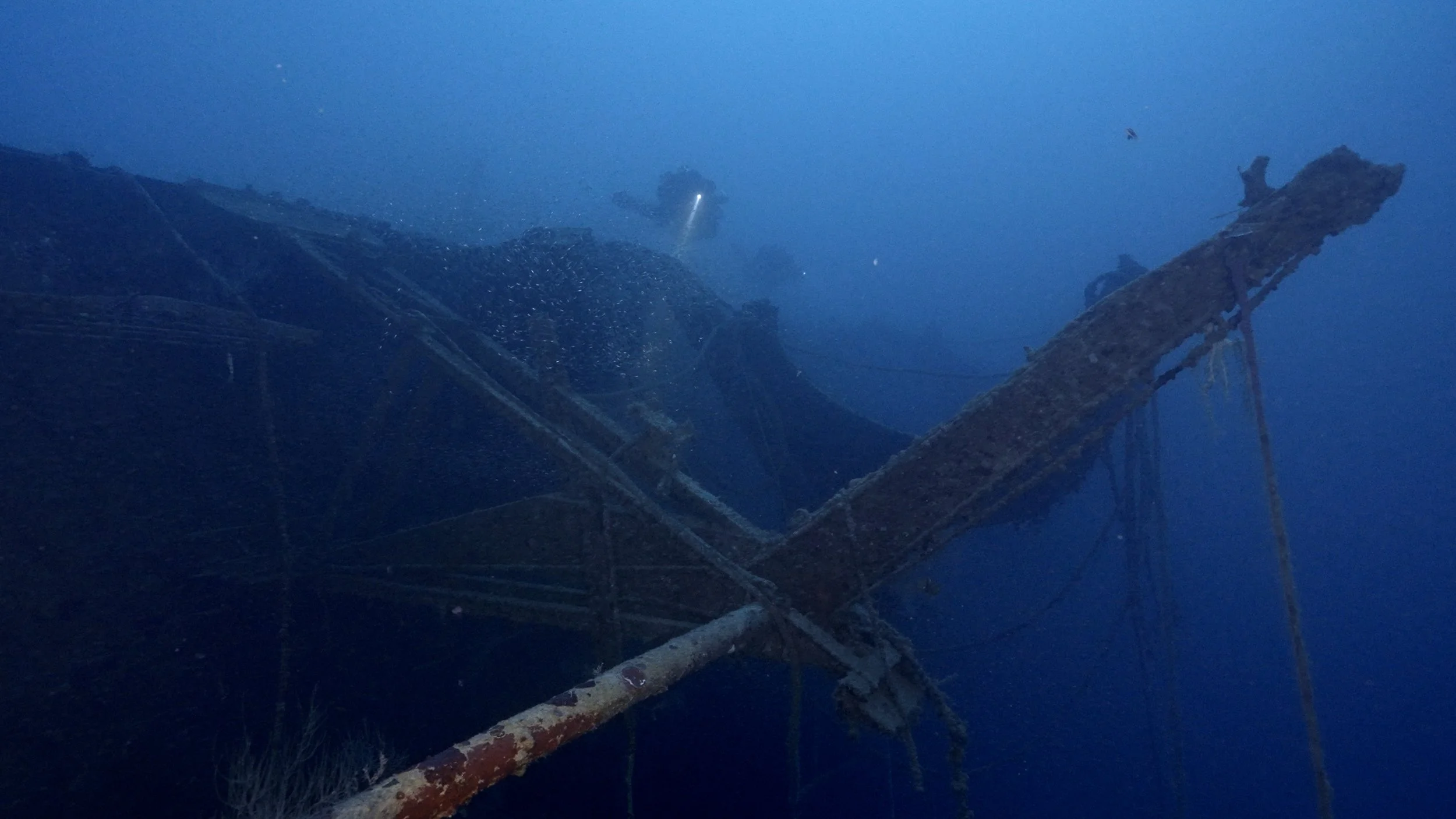
While shipwrecks are pollutants, they turn into artificial reefs and refuges for marine life, as if to apologise for the pain they’ve caused the ocean. At the shallowest point of Al-Qamar, sparse but present corals and hydroids seemed to feed by way of their tentacles, surrounded by schools of small fish grouping together to create the illusion of size, as their predators patrol the perimeter.
Within the vehicle hold of Al-Qamar, the only one of seven levels that appears to have been explored, there were more corals. I wondered how they existed in almost complete darkness, and what the lion fish present, were hunting, as they patrolled this large corridor. With six other levels, I was intrigued by what marine life may be seeking refuge within the rest of this vessel that once ferried over 700 people across the Red Sea.
It is worth mentioning that this wreck is surrounded by nothingness. The sediment it rests upon is soft, silty, and sinking, with a texture I imagine is akin to quicksand. There were no land masses or reefs in the vicinity. Thus, this wreck, while a pollutant indeed, has become a base - for small marine ecosystems to build homes, seek refuge, and feed, amidst the blue, seemingly infinite water.
Lastly, there was the goal of the dive, which was to film the wreck. Having already many minutes of decompression the moment we reached 86m, every moment at those depths accumulated long stops for our journey to the surface. Minutes at the bottom felt like seconds, and as I was filming with one hand, and was alternating between scootering and ensuring my life-support kept me alive with the other, the adrenaline was pumping.
The journey back was “simply” a matter of - “you must be the master of your mind, your mind mustn’t be the master of you”. With well over 90 minutes to spend at six and three meters, and precious little to observe, the test was one of mental resilience. As I grappled with feeling a sore back and starting to feel cold, I could see the rippling outlines of our surface support on the dive platform backlit by the boat lights glistening on the surface as the sun began to set. The surface was so close, but completely out of reach. It was imperative to block out thoughts of hunger, rest, and wanting to be dry and warm.
Four to five hours after we had descended, the team returned. With darkness quickly swallowing light as the sun set into the night, I had to fight the urge to move quickly and aggressively, as I was eager to get dry and warm. My body, still off-gassing; it needed me to be gentle, and measured.
This dive marked the very beginning of my journey into, and fascination with diving deep, technical wrecks; it is nascent still, and I have only just scratched the surface, but it is enduring.